.png "Levi, Ray & Shoup")



 Sign in with LinkedIn
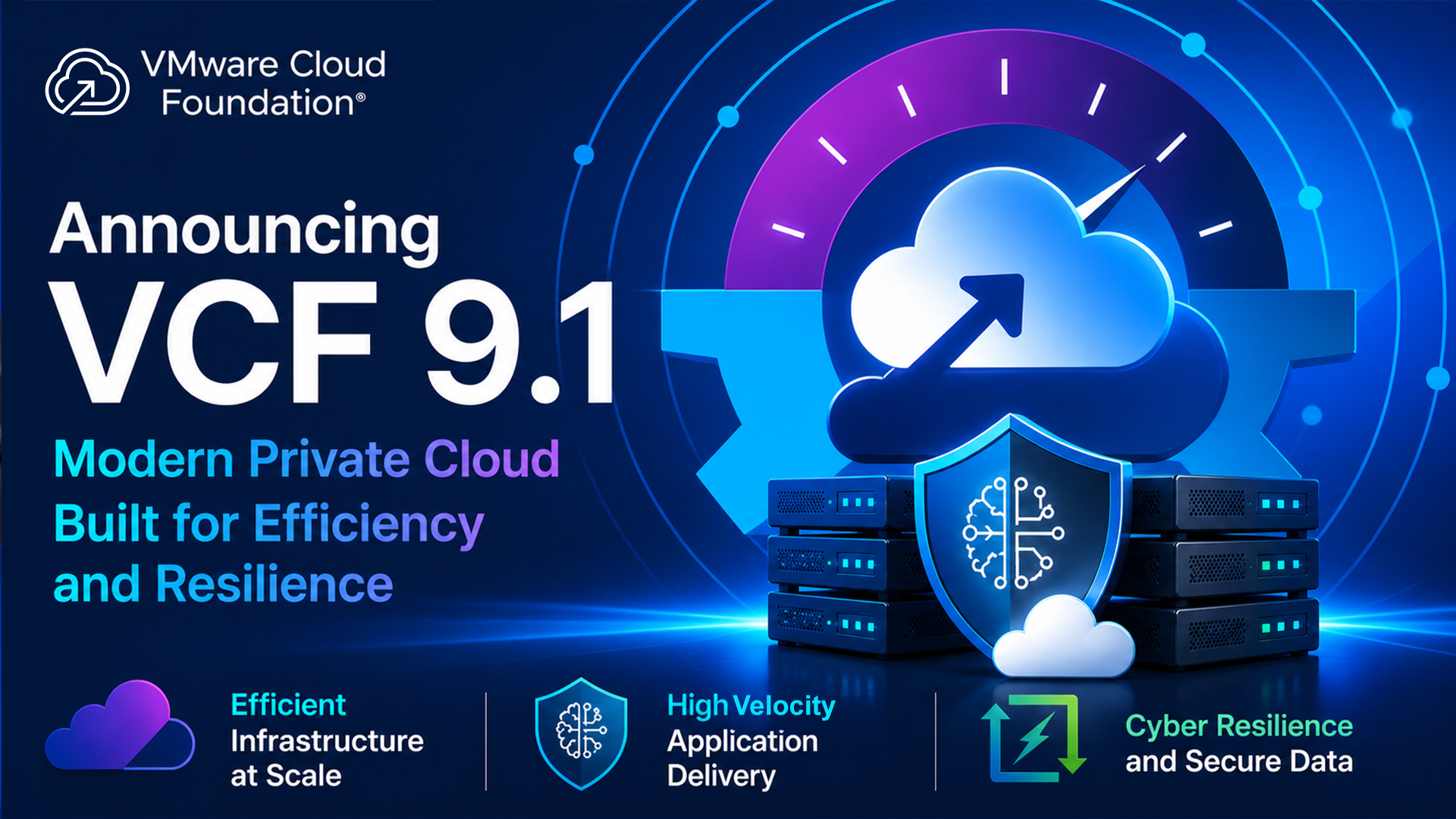
Announcing VCF 9.1: Modern Private Cloud Built for Efficiency and Resilience
What does it take to run more workloads, more AI, and stronger security without growing your budget? This blog post introduces VMware Cloud Foundation® 9.1, a unified private cloud platform built to improve efficiency, accelerate application delivery, and strengthen cyber resilience. See how enhanced memory tiering, lower total cost of ownership, and integrated security, compliance, and recovery help you do more with the infrastructure you own.
What problems does VMware Cloud Foundation 9.1 aim to solve?
VMware Cloud Foundation 9.1 is built for organizations whose environments keep growing in complexity while budgets and headcount stay flat. It focuses on three main challenges:
- Running more with the same resources: Environments now span virtual machines, containers, and AI workloads. VCF 9.1 helps you use existing infrastructure more efficiently through capabilities like:
- Enhanced NVMe memory tiering – hot data stays in DRAM while colder pages move to NVMe, increasing effective memory capacity without changing application behavior. This supports higher consolidation ratios and can help drive up to 40% lower total cost of ownership (TCO).
- vSAN global deduplication and enhanced compression – continuously reduces physical storage consumption across clusters, including in encrypted environments, by eliminating redundant data and improving compression efficiency.
- vSphere Elastic Provisioning – parallel imaging, automated host discovery, and consistent configuration to speed up host provisioning and make it easier to scale or repurpose capacity.
- Delivering applications faster and more consistently: The focus has shifted from just “where workloads run” to how efficiently they run and how quickly they can be delivered. VCF 9.1 supports this by:
- Scaling VMware vSphere Kubernetes Service (VKS) up to 500 Kubernetes clusters per Supervisor, which is especially useful for multi-tenant platforms and compliance-driven workload isolation.
- Introducing live application stack blueprints so teams can capture a running app (compute, network, storage) and redeploy it as a reusable template in minutes instead of hours.
- Adding native object storage for S3-compatible storage, simplifying how developers consume storage services.
- Strengthening cyber resilience without extra complexity: Security and recovery are treated as built-in platform capabilities, not bolt-ons. Key features include:
- vSAN for Recovery – uses native snapshots and integrated replication for both disaster recovery and ransomware recovery, helping you recover quickly while keeping operations simple.
- Advanced Cyber Compliance (ACC) – continuous compliance enforcement with automated assessment and remediation against baselines like VCF security guidelines and PCI DSS, plus drift detection and centralized visibility.
- Encrypted vMotion with hardware acceleration – secures workload mobility while reducing the usual CPU overhead of encryption.
- Live patching enhancements – apply critical security updates without planned downtime, helping maintain compliance and security posture with less operational impact.
Taken together, VCF 9.1 is meant to help teams move from simply “keeping the lights on” to running a more efficient, application-centric, and resilient private cloud with less operational overhead.
How does VCF 9.1 improve efficiency and application delivery at scale?
VCF 9.1 focuses on making better use of what you already have while simplifying how you deliver applications at scale.
1. Better utilization of compute, memory, and storage
- Enhanced NVMe memory tiering introduces a unified memory model where hot data stays in DRAM and colder pages move to NVMe. This increases effective memory capacity and supports higher consolidation ratios, contributing to up to 40% lower TCO without changing how applications behave.
- vSAN global deduplication and enhanced compression continuously reduce physical storage needs across clusters by removing duplicate data and improving compression. These features also work in encrypted environments, helping lower storage costs without a performance trade-off.
- Topology-aware scheduling improves performance on modern high core count processors by placing workloads more intelligently.
2. Faster provisioning and scaling of infrastructure
- vSphere Elastic Provisioning streamlines how hosts are brought online and assigned to workloads through parallel imaging, automated discovery, and consistent configuration. This reduces provisioning time and makes it easier to scale up or repurpose infrastructure as demand shifts.
- Parallel lifecycle operations increase upgrade scale, allowing you to run lifecycle tasks across large environments more efficiently.
- Real-time operational observability gives better visibility into infrastructure and workloads, helping teams troubleshoot and optimize faster.
3. Scaling Kubernetes and modern apps
- VMware vSphere Kubernetes Service (VKS) now supports up to 500 Kubernetes clusters per Supervisor. This is particularly useful if you’re:
- Running multi-tenant platforms for many internal teams, or
- Isolating workloads for compliance and security reasons.
- Faster provisioning of Kubernetes clusters and improved operational efficiency help reduce friction for DevOps and platform teams.
- Native object storage offers built-in, S3-compatible storage for applications that need scalable object storage, without relying on external platforms.
- Live application stack blueprints let you capture a running application (compute, networking, storage) and turn it into a reusable template. New environments can be deployed in minutes instead of hours, with no manual reconfiguration, which is especially valuable for DevOps teams provisioning at scale.
4. Support for AI-driven workloads
- Enhanced DirectPath I/O support for AMD Instinct MI350 Series GPUs helps virtualize AI workloads with better operational flexibility.
- Combined with features like live patching and high availability, you can maintain uptime during maintenance while scaling GPU resources dynamically to match AI demand, improving TCO for AI environments.
Overall, VCF 9.1 is designed to help you reimagine your private cloud as a platform that scales efficiently, delivers applications quickly and consistently, and supports modern and AI workloads without a full re-architecture.
How does VCF 9.1 strengthen security, compliance, and recovery?
VCF 9.1 is built to embed security, compliance, and recovery into the platform itself, so you can move from reactive measures to a more proactive and resilient operating model.
1. Integrated disaster and ransomware recovery
- vSAN for Recovery uses native snapshot capabilities and integrated replication workflows to protect workloads and streamline both disaster recovery and ransomware recovery.
- By leveraging deep snapshot chains, organizations can recover quickly while keeping operational processes consistent across environments.
2. Continuous compliance and security posture management
- Advanced Cyber Compliance (ACC) provides continuous compliance enforcement with:
- Automated assessment and remediation against baselines such as VCF security guidelines and PCI DSS benchmarks.
- Drift detection to identify when configurations deviate from approved baselines.
- Centralized visibility across the stack, helping reduce audit preparation time and enabling proactive remediation instead of reactive fixes.
- Improved visibility into security posture and operational state helps security and operations teams work from a shared, consistent view.
3. Secure workload mobility with less overhead
- Encrypted vMotion with hardware acceleration secures workload migrations while reducing the performance overhead typically associated with encryption. This allows you to maintain secure operations without sacrificing efficiency during migrations.
- vMotion encryption offload can deliver up to approximately 70% CPU savings during migrations by offloading encryption processing to hardware, improving application performance during movement and helping hosts return to steady state faster.
4. Minimizing downtime for security updates
- Live patching enhancements reduce the need for planned downtime by allowing critical security patches to be applied without disrupting running workloads.
- This helps maintain compliance and security posture while minimizing the operational impact of patch cycles.
5. Ecosystem integrations for stronger cyber resilience
- CrowdStrike EDR integration for cyber recovery workflows allows recovered workloads to be scanned in isolated clean room environments before returning to production. This helps lower reinfection risk and speeds safe recovery using tools many organizations already rely on.
- Networking ecosystem integrations with platforms like Arista, Cisco, and SONiC provide flexibility in how you connect and extend environments while maintaining a consistent security and operations model.
Together, these capabilities help you rethink your private cloud as a secure, compliant, and resilient platform, rather than a collection of point solutions that need to be stitched together and managed separately.